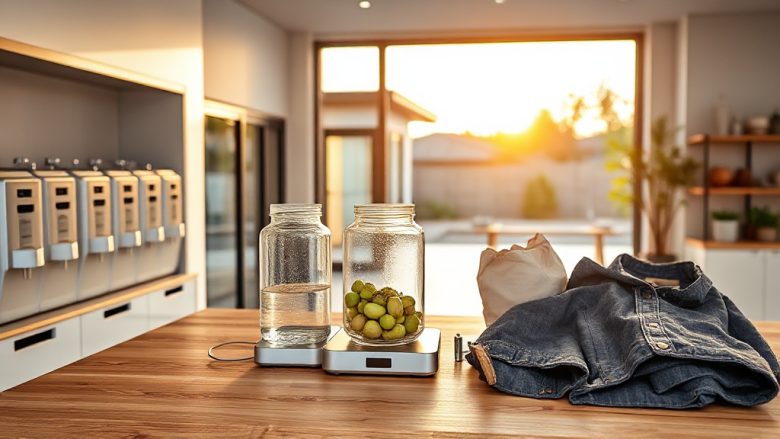
A trend only counts if it changes what a normal person can buy or do. That’s the test I use, and it’s a deliberately harsh one. Plenty of zero waste living trends to watch in 2026 are really marketing campaigns dressed up as movements. A brand announces a refillable concept, runs a glossy campaign, and nothing changes on the shelf. Meanwhile, a boring shift in how a supermarket packages mushrooms quietly removes a million plastic trays a year. The second kind is what matters.
So I went looking for the shifts that pass the test. Not the ones with the best press releases, but the ones that have reached the point where an ordinary household can act on them without hunting down a specialist shop or paying three times the price. A handful made the cut. Several didn’t, and I’ll explain which ones to ignore at the end.
How I Judge Whether a Zero Waste Trend Is Real
Three questions do most of the work. First, can you buy it or do it where you already shop? If a solution only exists in a single city or on a waiting list, it’s a pilot, not a trend. Second, does it cost roughly the same as the wasteful version? Anything that demands a significant premium stays niche, no matter how sincere the intentions behind it. Third, does it survive a busy week? A system that collapses the moment you’re tired and the dishwasher is full isn’t a solution, it’s a hobby.
By that standard, the zero waste living trends to watch in 2026 are less glamorous than the headlines suggest. They’re about infrastructure catching up with intent. The intent has been there for years. What’s changing now is that the practical barriers are finally coming down.
Refill Goes Mainstream, Just Not How Anyone Predicted
The refill shop was supposed to be the future. A few years ago, every town seemed to get one: jars of lentils, pumps of shampoo, bring-your-own containers. They were lovely. Many of them were also expensive, inconvenient, and quietly closed. The mistake was assuming people would change their shopping habits to accommodate the refill model, rather than the model adapting to how people already shop.
What’s actually working in 2026 is refill that arrives where you already are. Supermarkets have expanded their loose produce sections and, more importantly, started treating packaging as a design problem rather than an afterthought. Concentrated refill pouches for cleaning products have become genuinely normal, and the maths is straightforward: you buy a bottle once, then small pouches of concentrate that you dilute at home. The plastic drops by something like eighty per cent per use, and the price per wash is often lower than the ready-made bottle. That last point matters more than any eco-label.
For a household, the practical upshot is simple. You no longer need a dedicated zero waste shop to cut packaging significantly. You need to notice which products you buy repeatedly and check whether a concentrate or refill version now exists. Cleaning sprays, hand soap, laundry detergent, and dish soap are the easiest wins. Start there. Don’t try to overhaul everything in one weekend; you’ll burn out and revert.
There’s a caveat worth stating plainly. Some refill schemes are worse than the thing they replace. If a pouch is a laminated plastic sachet that can’t be recycled and the bottle it refills is shipped across a continent, the environmental gain shrinks fast. The honest position is that refill usually wins, but not always, and the difference often comes down to how far the concentrate travelled. Local beats clever.
Repair and Resale Move From Hobby to Habit
The single biggest shift in zero waste thinking over the past few years is the move away from recycling as the headline solution. Recycling is what happens when you’ve already bought the thing. Repair and resale happen before that, and they keep more material out of the waste stream by keeping products in use. In 2026, that idea has finally escaped the niche and reached ordinary high streets.
Repair cafés, once a monthly volunteer event in a church hall, have become more established. Some libraries now run repair sessions alongside book lending. A few retailers have started offering in-house repair for clothing and small electronics rather than pushing replacement. The change is modest but real, and it’s driven less by ideology than by cost. When a replacement costs a lot and a repair costs a little, people repair. When the reverse is true, they don’t. The trend is real because the economics have shifted.
Resale has followed a similar path. Second-hand clothing is no longer a compromise; for many people under thirty it’s the default. What’s new is the infrastructure behind it. Resale platforms have made listing and shipping simple enough that it takes a few minutes rather than an afternoon. Local swap events for children’s clothes, tools, and sports gear have become common in community centres and school halls.
At home, this changes what you do with things you no longer want. The old reflex was to bin them or leave them in a cupboard. The better reflex is to ask whether they can be repaired, sold, or passed on. A single drawer of unloved cables and chargers, sorted and offered locally, keeps a surprising amount of copper and plastic in circulation. It isn’t dramatic. It is, however, the kind of habit that quietly compounds.
One honest limitation: repair only works if spare parts exist. For cheap electronics, they often don’t, and no amount of good intentions fixes a device designed to be sealed. That’s a manufacturing problem, not a household one, and it’s worth saying so rather than blaming the consumer.
Packaging Rules and Loose Produce Change the Weekly Shop
This is the least glamorous trend on the list and probably the most consequential. Packaging regulations have been tightening across Europe and the UK, and the effects are now visible in shops rather than just in consultation documents. Deposit return schemes for drinks containers have rolled out further. Rules on single-use plastics have pushed some packaging out of existence entirely. Extended producer responsibility has started to make manufacturers pay more of the real cost of what they put on the shelf.
You don’t need to follow the policy detail to feel the difference. Loose fruit and vegetables are more widely available. More shops let you bring your own bags and containers for loose items. Some packaging has simply disappeared, replaced by nothing at all, because the cheapest compliant option was to stop wrapping the item.
For a household, the practical moves are unglamorous but effective. Buy loose where you can, especially for items that don’t need protection: onions, potatoes, carrots, apples, peppers. Keep a couple of lightweight produce bags in your usual shopping bag so you’re not caught out. Choose the larger container over the multipack of individually wrapped portions when the price is comparable. None of this requires a new identity or a pantry full of matching glass jars. It’s just a slightly different route around the shop you already use.
The sceptical note here is that packaging swaps can be cosmetic. A paper wrapper over a plastic tray is not progress. A compostable film that ends up in landfill because no one can compost it locally is not progress either. Watch what actually happens to the material after you put it in the bin, not what the label claims.
Which Zero Waste Trends to Ignore in 2026
Some things that look like trends are really just products looking for a problem. The biggest one is the wave of newly invented zero waste accessories. Bamboo cutlery sets, stainless steel straws you’ll use twice, branded tote bags made from virgin cotton, and subscription boxes full of small items you didn’t ask for. The pattern is always the same: buy something new in order to be less wasteful. It rarely works, and the manufacturing footprint of a reusable item only pays off after many uses. If you already own a fork, you own a reusable fork.
The second category to treat with suspicion is anything that shifts responsibility onto you while the system stays the same. A recycling label on packaging that can’t actually be recycled locally is the clearest example. So is a brand promising carbon neutrality while shipping single-use items around the world. Good intentions at the household level are real and worth acting on, but they can’t compensate for a product designed to be thrown away.
The third is the aesthetic version of zero waste: the perfectly organised pantry, the matching jars, the curated shelf. It photographs well and changes almost nothing. If a habit makes your life easier and cuts waste, keep it. If it exists mainly to be seen, it isn’t a trend, it’s a shopping list.
What’s left after all that filtering is a fairly modest set of changes. Refill where it’s cheaper and closer. Repair and resell before you replace. Buy loose where the packaging is pointless. Ignore the accessories. That’s the honest shape of zero waste living trends to watch in 2026, and it’s enough to make a real dent in what a normal household sends to landfill each week. The trends worth following are the ones that make the better choice the easier one. Everything else is noise.