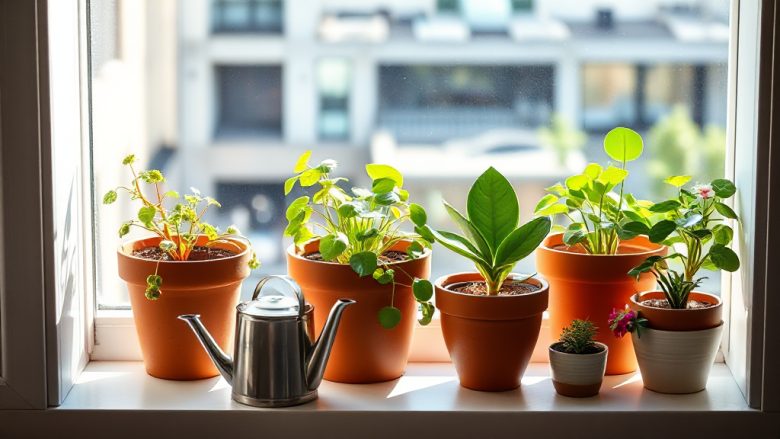
Most pot plants don’t die from neglect. They die from a pot that’s too big for their roots and a watering can that shows up whenever you happen to remember. I’ve lost three basils in a single summer learning this the hard way, plus a mint that drowned in a decorative planter I’d bought purely because it matched my balcony tiles. The plants weren’t the problem. I was, gently and repeatedly.
So here’s the list I wish someone had handed me back then. Eight easy plants to grow in pots, each with the single care rule that keeps it alive, plus a short cheat sheet at the end for pot size and watering. No botany degree required.
Why Pots Fail Before Plants Do
Roots need air as much as water. When you plant a small rootball in a huge pot, the soil around it stays wet for weeks while the roots sit in the middle doing nothing. That’s root rot, and it looks exactly like underwatering from above: droopy, yellowing, sad. Beginners then water more, which finishes the job.
The second killer is rhythm. A plant that dries out completely and then gets flooded goes into shock, drops leaves, and never quite recovers its shape. Consistent watering beats perfect watering every time. If you can only manage one thing, manage that.
Everything below tolerates a bit of imperfect care. Some tolerate a lot.
1. Pothos
Pothos is the plant that forgives you for going away for a week. It trails, it climbs, it roots happily in a glass of water on a windowsill, and it grows in everything from bright indirect light to a dim corner where nothing else survives.
One care rule: water when the top two inches of soil feel dry, then stop. Pothos sulks far more from soggy soil than from a missed watering. If the leaves start going yellow and soft rather than crisp, you’re overwatering, not underwatering.
It also tells you when it’s thirsty. The leaves droop slightly, you water, and within a few hours it’s back. That feedback loop makes it a genuinely good teacher for anyone learning to read plants.
2. Snake Plant
Snake plant, sometimes sold as mother-in-law’s tongue, is the closest thing to a plant that waters itself. Thick upright leaves store water, so it survives neglect that would kill almost anything else. It handles low light, dry air, and the radiator-adjacent spot nobody else wants.
One care rule: water roughly every two to three weeks in summer, and barely at all in winter. In a cool room, once a month is plenty. If you’re unsure, wait another week. The most common way to kill a snake plant is kindness.
One thing worth knowing: it hates sitting in a saucer of standing water. Empty the saucer ten minutes after watering and it’ll outlive most of your furniture.
3. ZZ Plant
ZZ plant has glossy, waxy leaves that look almost artificial, which is handy because it behaves like it too. It tolerates low light, irregular watering, and dry indoor air. It grows slowly, so it stays the right size for its pot for years.
One care rule: let the soil dry out completely between waterings, all the way down. ZZ plant stores water in underground rhizomes, so it can go a month without a drink and not notice. Wet roots, on the other hand, rot fast and quietly.
It’s a good choice for a north-facing windowsill or a hallway with no natural light to speak of. Just don’t expect it to grow fast. Slow is the point.
4. Spider Plant
Spider plant is cheerful, cheap, and almost aggressively generous. It throws out babies on long arching stems, and each one can be snipped off and potted up into a whole new plant. One purchase can fill a windowsill within a year.
One care rule: water when the soil surface just starts to feel dry, and use filtered or rainwater if your tap water is hard. Spider plants are sensitive to the fluoride and salts in tap water, which shows up as brown tips. It’s cosmetic, not fatal, but rainwater fixes it.
Bright indirect light keeps the stripes crisp. In deep shade the leaves go a flatter green and the plant gets leggy.
5. Aloe Vera
Aloe vera is a succulent with a job. Snap off an outer leaf, split it, and the gel inside is genuinely useful for minor burns and dry skin. It also happens to be one of the most forgiving plants you can put in a pot.
One care rule: water deeply, then let the soil dry out completely before watering again. In summer that might mean every ten days. In winter, every three or four weeks. Aloe wants to be treated like a desert plant because that’s what it is.
It needs the brightest spot you have, ideally a south-facing windowsill. A stretched, pale, floppy aloe is a sign it’s reaching for light that isn’t there.
6. Peace Lily
Peace lily is the drama queen of this list, but in a useful way. It droops theatrically when it’s thirsty, then perks up within hours of a watering. That makes it almost impossible to get wrong once you’ve seen it happen once.
One care rule: water when the leaves just begin to droop, and keep the soil lightly moist rather than soaked. It tolerates lower light than most flowering houseplants, though it flowers best in bright indirect light.
It’s also one of the few plants on this list that tells you clearly when something’s wrong. Brown edges usually mean dry air or inconsistent watering. Yellow leaves usually mean too much water. Either way, you get a signal before it’s too late.
7. Herbs: Mint and Chives
If you want something edible, mint and chives are the two herbs that survive beginner care. Both grow fast, both forgive a missed watering, and both keep producing if you harvest regularly.
One care rule: keep the soil consistently moist, not soggy, and water mint more often than you think. Mint in a pot dries out faster than mint in the ground because it has less soil to draw from. Chives are slightly more drought-tolerant but still prefer steady moisture.
Grow mint in its own pot, always. It spreads by runners and will colonise anything sharing its soil. Chives are better behaved and can share a wide, shallow container with other herbs.
Basil, for the record, is not on this list. It’s wonderful and it will break your heart. It wants full sun, consistent moisture, and pinching back, and it goes leggy and bitter the moment you look away. Start with mint.
8. Geranium (Pelargonium)
Geraniums are the classic balcony plant for a reason. They flower for months, handle wind and sun, and cope with being forgotten on a hot afternoon far better than most flowering plants.
One care rule: let the soil dry out between waterings, and deadhead spent flowers weekly. That’s it. Geraniums rot quickly in constantly wet compost, so err on the dry side. Removing faded blooms keeps new ones coming instead of the plant putting energy into seed.
They like full sun and a bit of airflow. A crowded, still corner encourages mildew, which shows up as grey powdery patches on the leaves. Space them out and it rarely appears.
Pot Size and Watering: A Three-Line Cheat Sheet
Pot size: choose a container roughly two inches wider than the rootball, no more. A plant in a pot that’s too big sits in wet soil and rots. You can always size up next year.
Drainage: every pot needs at least one hole, and every saucer needs emptying after watering. A decorative pot with no hole is a cachepot, not a home. Keep the plant in a nursery pot inside it.
Watering: stick a finger in the soil up to the second knuckle. Dry that far down, water until it runs out the bottom. Still damp, walk away. That single habit prevents most pot plant deaths, including the ones on this list.
One more thing worth saying plainly: terracotta dries out faster than plastic, and small pots dry out faster than large ones. A four-inch terracotta pot on a sunny windowsill might need water every two days in July. The same plant in a ten-inch plastic pot might need it once a week. Check the soil rather than following a schedule.
Start With Three, Not Eight
You don’t need all eight of these. Pick three that suit the light you actually have, not the light you wish you had. A dark flat rules out aloe and geraniums. A blazing south-facing windowsill will scorch a peace lily. Match the plant to the spot and half the battle is already won.
Then give yourself a season to get it wrong. Every gardener I know has a graveyard phase, and mine lasted longer than I’d like to admit. The plants on this list are chosen precisely because they survive that phase with you. Water when the soil tells you to, use a pot that fits the roots, and empty the saucer. That’s the whole secret, and it’s a lot less mysterious than it looks from the outside.